$ cat posts/kandinsky-and-the-functional-argument.md
Kandinsky and the functional argument
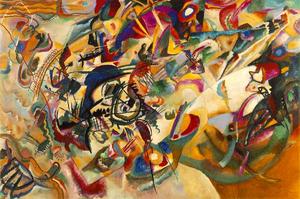
When you first approach a work of abstract art, like this beautiful painting by Kandinsky, the first thing you usually ask yourself is “what is this?”, or also what did the painter mean to express?.
Some approach it naively, some reject this kind of art.
Others give up on the questions and devote themselves to appreciating it aesthetically.
For Kandinsky a work of art was effective if it arose from an inner need of the artist and if the artist’s original impulse is evoked in the viewer through the artwork and its reception.
The question Kandinsky would have liked to hear is: what does this painting evoke in me?.
“Music is the ultimate teacher”
Aspiring to the evocative nature of music, the most supreme of the arts, was at bottom the Russian painter’s ambition.
If we listen to a melody, we’re very unlikely to ask ourselves anything; the music will stir feelings in us, bring back memories, evoke emotions.
The functional questions
Unlike with a painting, when we’re faced with software the first thing we ask is what is it for?, or equivalently, what does this program do?
We rarely ask what a work of art is for, unless we’re psychologists :smile:.
When we’re going to develop software, the first thing we professionals in the field do is the requirements analysis. What we’re trying to find out is what the software is going to be used for. From that we produce the functional design of the system, that is, we define the domains of the inputs and the outputs, along with the functions that transform those inputs into the desired outputs.
This is essentially the functional argument, which helps us explain why software is different from other intellectual creations.
It’s one of the many arguments showing that the Nature of Software is so different from anything else human beings have ever created in their history.
In a recent article by Claudio Ruiz, we’re told that all intellectual creation is subject to copyright.
However, this notion is wrong, and it can’t be applied so directly to software, because software is essentially different, and can’t be equated with a work of art, much less with a literary work, as the Berne Convention holds, and as Raspu reminds us
Legislation should start to reflect the essentially different nature of software.
One more reason to rethink our notions of intellectual property.
Comments
comments powered by Disqus